Σάββατο 24 Νοεμβρίου 2012

Chinese New Year Missions Breakfast


CNY Header
The Fellowship of St John the Divine is proud to report that $932 has been raised during this past Sunday's Chinese New Year's Breakfast after Liturgy, with a higher than expected turnout compared to previous years. Special thanks goes to everyone who helped and those who contributed as the event shows true synergy from the kitchen to the church hall and among the parishioners, both young and old.

All food and drinks have been donated so 100% of contribution goes straight to the Chinese Translation Project via the Orthodox Fellowship of All Saints of China. The funds will go towards the liturgical translation effort of our translator in Shanghai, who has completed portions of the Great Book of Needs, Horologion, Sunday Octoechos, Festal Menaion, Lenten Menaion and Pentecostarion. This will familiarize the Chinese with the sacramental and liturgical life of the Orthodox Church. When indigenous clergy are ordained in due time in China, this will provide opportunity for the Faithful to worship in their local language.

Created with flickr slideshow from softsea.

Presented by the Fellowship of St John the Divine to benefit the Chinese Translation Project via theOrthodox Fellowship of All Saints of China (OFASC)
Place: St Mary Antiochian Orthodox Church, 8 Inman St, Cambridge MA
Cost: Suggested min. donation $5 per adult (checks can be made payable to “St. Mary Orthodox Church – Fellowship” earmarked to Chinese Missions)
Date and Time: Sunday February 6, 2011 after Divine Liturgy (Snow Date TBA) 
RSVP: Nelson Mitrophan Chin at mitrophan@orthodox.cn by Wednesday February 2
StampThis February 3rd marks the start of a new year in the Chinese lunar calendar. It is referred to as the Spring Festival in China, and marks the year of the Rabbit. (Twelve animals are designated through a 12-year cycle.)
At St Mary’s we will celebrate the Chinese New Year on Sunday February 6 with a Chinese Missions potluck breakfast, after the Divine Liturgy, to benefit the Chinese Translation Project via the Orthodox Fellowship of All Saints of China.
OFASC, now in its fifth year as a 501(c)(3) non-profit corporation governed by an international, pan-Orthodox board of trustees. OFASC was recently awarded a grant renewal of $3,000 from The Order of St Ignatius of Antioch with the blessing of Metropolitan Philip towards the continuing translation and publication of monthly volumes of The Prologue from Ohrid with additional lives of saints from othersynaxaria.
OFASC is also partnering with the Institute of Sino-Christian Studies (ISCS) in Hong Kong to publish in Chinese of The Orthodox Church with the blessing of its author Met. Kallistos (Ware), made possible with a grant from Virginia H Farah Foundation.
Please RSVP with the number of people attending and any diet restrictions. Also let us know if you are interested in donating a dessert or main dish, or to provide a helping hand with setup, food prep or cleanup. The parish kitchen will be opened for reheating or cooking.

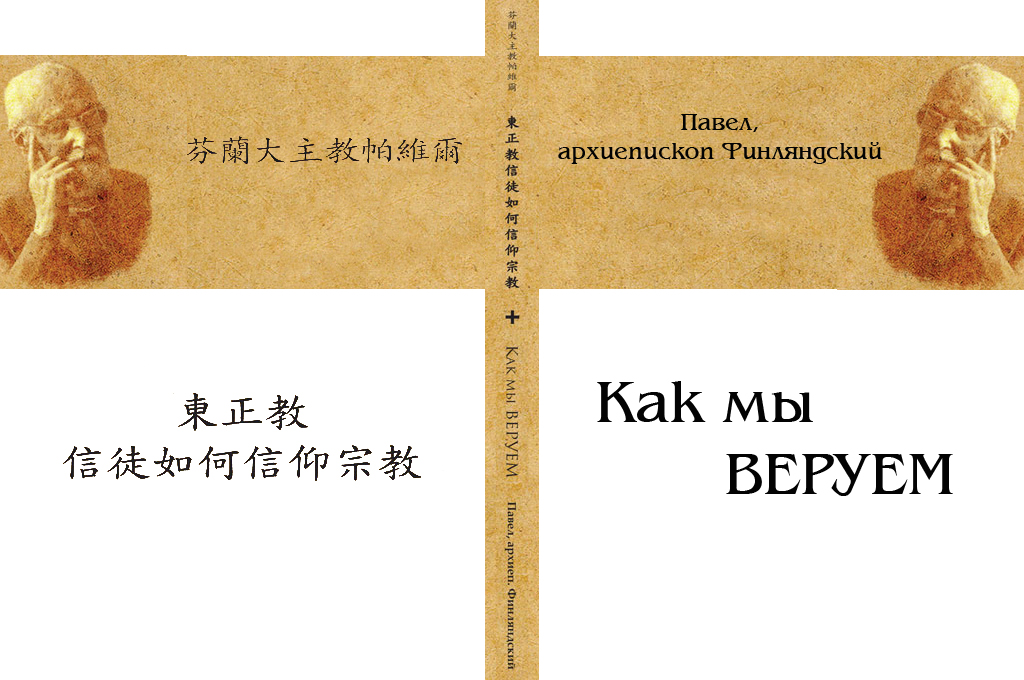
The Faith We Hold” by Archbishop Paul (Olmari) is released in a Russian-Chinese edition


by OCP on AUGUST 10, 2012
The Chinese Orthodox Church
10/8/2012

English translation by Nina Tkachuk Dimas
PRAVMIR. “The Faith We Hold”, the well-known book by Archbishop Paul (Olmari) of Finland has been released jointly by the publishing house “Alavastr” together with Hong Kong’s Orthodox Brotherhood of the Holy Apostles Peter and Paul.
The author succinctly sets out the basic doctrine for a reader unfamiliar with the systematic theology of the Orthodox Church.
The publication is dedicated to the 300 hundredth anniversary of the Beijing Mission which is being observed this year. This is the first Russo-Chinese edition using traditional Chinese characters for Chinese readers.
The publication was approved by the [OFASC] Commission on Translation of Orthodox literature into Chinese. The book was published in Russia in collaboration with Metropolitan Longin of Saratov and Volsk

Toward a rebirth of the Orthodox Church in China - Interview with Mitrophan Chin


While the presence of Western Christian Churches in China is a well-known fact, many people are not aware that the Orthodox Church has also been present in that country for more than 300 years. In this interview, the webmaster of Orthodox.cn, Mitrophan Chin, tells us more about the history, current situation and prospects for the Orthodox Church in China. 

The Orthodox Church in China was given a status of autonomy by the Moscow Patriarchate in 1956 and had two Chinese bishops, several priests and possibly up to 20,000 faithful in the early 1960s.

But it has never fully recovered from the turmoils of the "cultural revolution" of the 1960s and its antireligious policies. In December 2004, the last Chinese Orthodox priest living in China, Father Alexander Du Lifu, passed away in Beijing at the age of 80. He did never manage to get permission from the government to open a church in Beijing: the authorities argued that the community (about 300 faithful) was too tiny.

However, there are efforts from several sides to revive Orthodox life in China, and a few Chinese students are reported to be currently training in Russian theological schools. According to estimates by Father Dionisy Pozdnyaev, who is in charge of Chinese affairs at the Department of External Relations of the Moscow Patriarchate, there are some 13,000 Orthodox faithful living in China. There are parishes - without clergy - in Xinjiang, in Inner Mongolia and in Harbin, where the Russian church building is a local landmark. The Moscow Patriarchate would like to see the Orthodox Church recognized officially, but its small size seems to present an obstacle.

Attempts to revive Orthodoxy in China also take place in virtual space. An Orthodox believer of Chinese background living in the United States, Mitrophan Chin, is the webmaster of the website Orthodoxy in China (http://orthodox.cn), which was launched in Spring 2004. In this interview, he tells us more about the history, current situation and prospects for the Orthodox Church in China.


Mitrophan Chin, webmaster of Orthodox.cn.
Religioscope - How did Orthodoxy reach China first, more than 300 years ago?

Mitrophan Chin - Orthodoxy reached China with the eastern expansion of the Russian empire across the Siberian Far East in 1651. At around the same time in 1644, the Ming dynasty was overthrown in China by the Manchurians who introduced the Qing dynasty which lasted until the Nationalist revolt of 1911. The Russian Cossack settlements along the Amur River at Albazin eventually was met by fierce attacks by the Chinese army in 1685 which led to the downfall of Albazin, and the captives were taken to the capital city of Beijing.

Religioscope - The first Orthodox in China could thus be described as "immigrants". When did missionary activities directed toward Chinese begin, and how successful were they?

Mitrophan Chin - Missionary activities started when a number of the original captives of the Albazinians were given the honor to serve the Chinese Emperor Kangxi in the Imperial capital of Beijing in one of the most prestigious banners of the honor guards. The first Orthodox priest, Fr Maxim Leontiev, was sent unwillingly to provide spiritual guidance to these new Albazinian immigrants. An old Buddhist temple was provided at the northeastern corner of the capital, and it was converted to an Orthodox chapel bearing the name of St Nicholas the Wonderworker in honor of the miracle-working icon that Fr Maxim brought along with him.

Thus the seed of the Russian Ecclesiastical Mission has been planted on Chinese soil. In the 200 years leading up to the Boxer Rebellion of 1900, the Mission took in only a small number of indigenous Chinese converts, mostly through inter-marriage with the Albazinians. This stood in stark contrast with active missionary efforts by rival Catholic and Protestant missionaries.

Religioscope - Orthodoxy in China had its first martyrs at the time of the uprising of the Boxers, which not only targeted Catholics and Protestants, but Orthodox as well. Your Christian name, Mitrophan, is the name of a martyred Chinese priest, isn't it?

St. Mitrophan - icon painted by the Sisters of the Holy Nativity Convent.
Mitrophan Chin - St Mitrophan, along with over 200 other Chinese and Albazinians in Beijing gave their lives up for the Christian faith during the Boxer Rebellion of 1900, or the Yihetuan Movement as the Chinese called the uprising. Albazinians at this time have pretty much assimulated with the local population after two centuries of cohabitation. Their outward appearance is not much different from the majority Han Chinese population even though ethnically they consider themselves of Russian descent.

Religioscope - After the Bolshevik revolution in Russia, many Russians fled East and settled in China, where there was during a few decades a very active church life. When did those Russian emigrants then leave China? Are there still some of them left?

Mitrophan Chin - The Orthodox population swelled in the 20th century in China, mostly due to the influx of white Russians. At the same time, the Boxer uprising had not stopped the blood of the Martyrs from bringing forth a new generation of Chinese believers. Archimandrite Innokenti Figurovsky, who in 1902 became the first Bishop of Beijing, initiated translations of liturgical and catechetical Orthodox material for the first time into spoken Chinese called guanhua.

This was considered the golden era of Orthodoxy in China, with many churches being built. Unfortunately, most of the Russians fled China when the Communists took over in 1949. Some returned back to Russia but many others immigrated to Australia or America.

The famous St John, who was Archbishop of Shanghai, was one of the last to leave when the Communists took over and eventually settled in California. Also, Fr Elias Wen, who was the rector of the Church dedicated to the Surety of Sinners Icon of the Theotokos in Shanghai fled to Hong Kong and eventually immigrated to San Francisco. Fr Elias is the oldest Orthodox priest still alive and will be approaching 108 years of age this November. May God grant him many years!

Also, the priest Michael Wang, and protodeacon Evangelos Lu stayed behind in Shanghai and suffered much through the Cultural Revolution (1966-76). They have likewise reached an old age and have withdrawn from active clerical involvement as there are no functional Orthodox Churches in Shanghai. Another protopriest Michael Li, also originally of Shanghai, immigrated to Australia and serves as the spiritual father of Russian-Chinese Orthodox Missionary Society of Sydney.

Today, there are a few hundreds of Albazinian or Russian descent who consider themselves Orthodox that reside in each of the major cities of China, such as Beijing, Shanghai, and Harbin. Many more are scattered in the western and northern autonomous regions of Xinjiang and Inner Mongolia. In all, the most recent Chinese census have recorded around 13,000 Chinese citizens of Russian descent.

Religioscope - How did the Church first manage to continue its activities under the Communist government? What happened then to Chinese Orthodox at the time of the "cultural revolution"? Did some type of underground church life continue, insofar we know it?

Mitrophan Chin - The Church was required to be independent by Chinese government. Therefore the archbishop Victor consecrated archimandrite Vasily to be the first Chinese bishop of Beijing in preparation to lead the Church to autonomy which was eventually granted in 1957. The Cultural Revolution destroyed most of the Church buildings and many believers were persecuted. Church life was practically eliminated and the believers have to resort to reader services in private homes to continue living their faith.

The Chinese Martyrs icon mounted at the entrance to the Orthodox Church of St. Luke the Evangelist in Hong Kong was commissioned to the famed Greek iconographer Maria Sigala.
Religioscope - In recent years, there have been attempts by several Orthodox Churches to help Chinese believers. The Moscow Patriarchate has been quite active, including attempts to convince the Chinese government to register the Church. The Ecumenical Patriarchate (Constantinople) has established a diocese in Hong Kong - which is now part of Chinese territory - in 1996, serving South Asia and the Far East. Moreover, priests of the Russian Orthodox Church Outside Russia have also been regular visitors to the Chinese mainland. Those visiting priests have performed baptisms and celebrated liturgies for scattered communities of believers. Would you please summarize those efforts?

Mitrophan Chin - Efforts by non-indigenous priests have been hampered, including the recent deportation of an Orthodox priest who was secretly crossing the border between serving the spiritual needs of the Orthodox Faithful in Xinjiang in the western frontiers of China in December 2003.

The Chinese government is usually flexible with small group prayers in private homes, but they will start noticing if there are more than a handful gathering together. Visiting priests usually have to work within the supervision of the State Administration of Religious Affairs if they do not wish to encounter any obstacles, and for the most are only allowed to hold services for foreign compatriots working or residing in China. Such services are normally held in an embassy and are off limit to Chinese believers.

Religioscope - The major step to be taken seems to be the registration of the Church. Are there indications that this might take place in a foreseeable future? And what about those Chinese priests now in training in Russian seminaries?

Mitrophan Chin - The Chinese seminarians in the Russian seminaries do hope to return back to China to serve the Orthodox faithful there. This is a sensitive issue and requires the blessing of the Chinese goverment and their future is uncertain.

Russian President Putin has visited China, and has promised the Bishops Council of the Moscow Patriarchate that he will bring up with the Chinese authorities during his visit to allow an iconostasis which has been held up in customs for four years, to finally enter China to be installed in a church temple built by the Chinese goverment in 1999 in Inner Mongolia Autonomous Region.

The Chinese government has been seen as more accomodating in recent years including allowing a hieromonk from Russia to visit the Pokrov Church in Harbin to hear confessions in both Russian and Chinese in July 2004, and also the August 2004 visit by Russian Bishop Mark to Beijing at the official invitation of local religious leaders and the State Administration of Religious Affairs.

Religioscope - I understand that there are also efforts for reaching diaspora Chinese. For instance, a few months ago, the Russian Orthodox Church has decided to celebrate liturgies in Chinese in Vladivostok and other places of the Russian Far East. Are there already small groups of Chinese-speaking Orthodox outside of mainland China?

Mitrophan Chin - Vladivostok Diocese has a creative missionary endeavor by actually allowing its church to serve as a one of the tourist sites for Chinese tourists visiting the city. The church has prepared an explanation of the Orthodox Church and its divine services in Chinese which is given to the tour guides to explain to the visitors, and at the end of the tour, the tourists actually get to light a candle in front of an icon of the Chinese Martyrs.

Not only tourism but Chinese immigrants outside the Chinese border in Russia have swelled tremendously. They have been seen as a rival economic force in Russia, as evident when the recent Bishop Council of the Russian Orthodox Church brought up this demographic issue with President Vladimir Putin. Putin turned the table around and asked the bishops about the conversion of the Chinese to Orthodoxy, since Orthodoxy has always been universal or catholic, and, furthermore, Putin emphasized that each person's spiritual state is important.

Religioscope - Let's now come to your website. Orthodoxy in China -http://orthodox.cn - seems to be on its way to become a major ressource for Orthodox material in Chinese as well as for information on Orthodoxy in China. Could you tell us more about the content and purpose of this website?

Mitrophan Chin - Orthodox.cn is created to be the portal of everything you will ever want to know concerning Orthodoxy as it developed in China and its environs, and especially where it is today and where it will be tomorrow. Catechetical literature and liturgical texts in classical and modern Chinese are gathered here for easy access for anyone interested in learning more of what Orthodoxy have to offer.

Links to various Internet resources and Chinese Orthodox discussion boards are also provided to take advantage of the strength of the Internet in providing a wealth of information and exchange of ideas which no one site can provide.

News articles related to Chinese Orthodoxy from Russian language media are translated into English and disseminated to keep the international English-speaking community in the loop concerning missionary activity made from the Russian Orthodox part of the world.

Religioscope - You intend also to make liturgical and devotional material available in Chinese. Are most Orthodox liturgical texts already available in Chinese? Are they being reprinted, or is the Web currently the best solution to make them available again?

Mitrophan Chin - Currently, an online library of most of the extant classical Chinese Orthodox text that were produced in the 19th and early 20th century Russian Ecclesiastical Mission in China have been scanned in and being made available for free distribution via the web, which is the most economical and quickest way for those in China to get a personal copy of these rare historical texts. More recent Chinese translations suitable for the younger Chinese generation have also been made available online for the daily prayers with various canons and akathist plus the divine liturgy of St John Chrysostom. Most of this freely distributable material can be burned onto CD upon request for those in China without convenient Internet access, and they are encouraged to copy and share with family and friends.

Religioscope - An ambitious project which you have is the Chinese translation of the Prologue of Ohrid, a collection of lives of the saints for every day of the year...

Mitrophan Chin - This project has been spurred by a Hong Kong Protestant who did preliminary translation of half a year's readings of the the lives of saints section of the Prologue of Ohrid. He has passed the torch to a Chinese Orthodox convert currently living in Romania to revise and complete translating the rest of the readings including hymns, contemplation, reflections and homilies. The fruits of this project will greatly enrich the daily devotional life of the Orthodox faithful in China and also to introduce the riches of Eastern Orthodoxy to our non-Orthodox readers.

Religioscope - While your website is a useful resource for people who would like to know more about Orthodoxy in China, it is also meant as a service to Orthodox faithful living in mainland China, a country where there are already several dozens of millions people online. Do Orthodox believers in China use the Web and write to you for material?

Mitrophan Chin - Most Orthodox believers that are online are mostly converts and are usually self-motivated in seeking out the truth. They usually post anonymously to various online religous message boards to ask questions about the Orthodox faith. In the physical world, many times they would be drawn by the beauty of some of the restored Orthodox churches in China and would travel to visit such former churches like the St Sophia in Harbin or they may be curious and go seek out the existence of any former Orthodox church buildings that may have survived the destruction caused by the Cultural Revolution and ask around if there are any cradle Orthodox believers in the vicinity. Since mainstream Chinese media lacks coverage of Orthodox concerns, the web site also provides a much needed international and domestic Orthodox newsfeed in Chinese.

Religioscope - Are there also other Orthodox websites in Chinese?

Mitrophan Chin - The parish website of Holy Trinity Orthodox Church in Taiwanis also in Chinese, but uses traditional Chinese characters which are different from what is taught in mainland China which uses simplified characters, introduced by the Communist government to combat illiteracy among the vast Chinese population. The Holy Trinity parish is under the pastoral care of the Metropolitanate of Hong Kong and South East Asia, and His Eminence Metropolitan Nikitas has given his blessing to allow the use of their Chinese Orthodox material from their site to be hosted on Orthodox.cn in Simplified Chinese catered to the mainland Chinese audience.

XINJIANG: Security service investigation followed Orthodox priest's deportation

Kazakhstan-based Russian Orthodox priest Fr Vianor Ivanov had visited China's north-western Xinjiang region to serve the local Orthodox who have no priests, but in December 2003 was detained by Chinese customs, was interrogated for a week, had his religious literature confiscated and was deported. "They questioned me for five hours a day. The special services representatives proved to be amazingly well-informed," Fr Ivanov told Forum 18 News Service. Local Orthodox told Forum 18 in Xinjiang in early September that virtually all the Orthodox believers in the city of Ghulja were questioned by the security services about Fr Ivanov's activity. In Ghulja the Orthodox can at least meet for prayers in church without a priest, but in another Xinjiang town, Tacheng, local Russian Orthodox have had no success so far in applying to rebuild their church.
In the wake of the detention and eventual deportation from China last December of Kazakhstan-based Russian Orthodox priest Fr Vianor Ivanov, who had been working among the Russian Orthodox minority in the Ili-Kazakh autonomous prefecture in China's north-western Xinjiang-Uighur Autonomous Region, Forum 18 News Service has learnt that the Chinese security services began an investigation into what Fr Ivanov had been doing in the region. Local Orthodox told Forum 18 in the prefecture's capital Ghulja in early September that virtually all the Orthodox believers in the city were questioned by the security services about Fr Ivanov's activity after he was deported.

Dean of Zharkent district in the Astana and Almaty Orthodox diocese, Fr Ivanov was arrested by Chinese customs officials in December 2003 after trying to bring Orthodox literature and baptismal crosses into China, he told Forum 18 on 6 September from Zharkent, a town on the Kazakh side of the border with China, 350 kilometres (220 miles) east of Kazakhstan's commercial capital Almaty.

Fr Ivanov was taken to Ghulja, 100 kilometres (60 miles) east of the Kazakh border and 600 kilometres (375 miles) west of Xinjiang's capital, Urumqi. He was held under house arrest in a hotel for one week and each day was taken for questioning by the state security services. Fr Ivanov was then deported back to Kazakhstan. All his religious literature and baptismal crosses were confiscated.

"They questioned me for five hours a day. The special services representatives proved to be amazingly well-informed," Fr Ivanov told Forum 18. He said they knew all about his previous visits to Xinjiang, where he had baptised local Russians and dedicated Ghulja's Orthodox church. "They had clearly come over the border into Kazakhstan and visited Zharkent to gather information about me."

"I myself am not surprised by what happened to Fr Ivanov," an Orthodox representative told Forum 18 from Almaty. "China remains a communist country with all that goes with that." The representative pointed out that Xinjiang has just two Orthodox churches, in Ghulja and in Urumqi, and neither has a priest. "Chinese law bans foreign priests from working in the country on a permanent basis and there are simply no local Orthodox priests left in China."

One politically well-connected local Russian, Nikolai Lunev, a deputy for the tenth All-Chinese Political Consultative Council, a consultative body incorporating China's national minorities, played down any difficulties for the Orthodox. "I myself have not heard anything about Ivanov being deported, but I met him in Urumqi and warned him that under our legal system a priest could work in Xinjiang only with the permission of the authorities," he told Forum 18 on 2 September in Ghulja. "If he was deported, that is his fault because he broke our laws."

He regarded as "decisive proof" that Orthodox believers have "full rights" the fact that in 1992 the authorities restored at their own expense the Church of St Nicholas in Ghulja, which had been destroyed during the Cultural Revolution.

An elder at St Nicholas Church, Galina Merkuleva, agreed with Lunev. "Under Chinese law we do not have the right to hold meetings if our community is not registered. Now we can meet publicly for prayers in our own church, which we simply would not have been able to do without the help of the authorities," she told Forum 18 in Ghulja on 3 September.

However, some in Ghulja's Orthodox community are far more sceptical about the authorities' goodwill than Merkuleva and Lunev, pointing out that the church was not rebuilt on its original site, where the plot remains vacant, but in the Russian Orthodox cemetery.

"Under Chinese law the land occupied by churches destroyed during the Cultural Revolution ought to be returned to the religious communities, but the plot where the Orthodox church once stood has been given not to the religious community but to a private individual who is not an Orthodox believer," members of the Ghulja Orthodox community, who preferred not to be named, told Forum 18 on 4 September. "Had they given the plot of the former church back to us, we could have rented part of the land to him, which would have enabled us not only to restore the church but also to support the poor members of our community from the remaining funds."

The Orthodox also expressed their disappointment that every time they want to ring the church bell, they have to ask the authorities' permission. The authorities told the Orthodox that these restrictions are in place because Muslims are not allowed to issue the call to prayer using loudspeakers, and China treats believers of different faiths equally.

Orthodox believers in Tacheng, a town near the Kazakh border, 600 kilometres (375 miles) north-west of Urumqi where there is another sizeable local Russian population, have had less success re-establishing church life. "Our church was destroyed during the Cultural Revolution. So far, unfortunately, it has not been restored," the head of Tacheng's Russian community, Valentin Belyakov, told Forum 18 on 6 September. "But we have appealed to the authorities to help us restore it."

Belyakov also expressed concern about the city's Orthodox cemetery. "The cemetery is in a derelict state. Building clay is constantly being deposited around it. We also hope to resolve this issue soon with the help of the authorities," he told Forum 18.

The head of the Hong Kong Orthodox parish of the Apostles Peter and Paul Fr Dionisy Pozdnyayev, who works with Chinese Orthodox believers under the auspices of the Moscow Patriarchate, told Forum 18 of his overall optimism regarding the future of Orthodoxy in China. "It is possible to find a common language with the Chinese authorities," he told Forum 18 from Hong Kong on 6 September. "The main thing is not to break the laws of the country and to make requests directly to the republic's authorities."

He admitted that there is just one Orthodox priest and one deacon in China at present, but believed it is possible to resolve this issue. "If a request is made, the Chinese authorities will very likely give permission for Chinese citizens to study in Russia's Orthodox seminaries. Fifteen Chinese citizens are already studying in Russian seminaries," Fr Pozdnyayev declared. "The main thing is not to demonstrate independence and to respect Chinese law."

China's national authorities have so far prevented the Chinese Autonomous Orthodox Church destroyed in the Cultural Revolution of 1966-76 from reviving. Beijing's last surviving Orthodox priest died last December, while the city authorities have repeatedly denied requests to allow a parish to be reopened in the city (see F18News 18 December 2003 http://www.forum18.org/Archive.php?article_id=216 ).

The history of the Russian community in Xinjiang can be divided into four stages: from the start of Russia's colonisation of Central Asia until 1920; the period after 1920, when White forces were driven out of Russian territory into Xinjiang; the period after 1932, when people unhappy with collectivisation in the Soviet Union fled to Xinjiang; and the period from 1954 to the present, when Russians have left Xinjiang for Australia and Russia.

By about 1925 the picture of Russian settlement in Xinjiang had become established, and it remained unchanged until the second half of the 1950s. Ghulja became the centre of the Russian diaspora, with Tacheng and its surrounding districts next in terms of population, followed by Urumqi. In the 1930s, the Russian population in Ghulja and Tacheng approached several thousand and Ghulja even had a Russian-language newspaper.

After China's Cultural Revolution, virtually all Xinjiang's Russian population emigrated to Australia and the Soviet Union. According to official statistics around 2,000 Russians live in Xinjiang-Uighur autonomous region. However, almost all of them are of mixed race, with one Russian parent and one Chinese parent. Most of these people or their parents were deported from the Soviet Union on Stalin's orders after relations between the Soviet and Chinese governments deteriorated. 

CHINA: Will Orthodox Christians soon be allowed priests?


By Geraldine Fagan, Forum 18 News Service <http://www.forum18.org>
China's estimated 3,000 scattered Orthodox Christians may soon be able to have their own priests once again. Since 2003, 15 Chinese Orthodox have been studying in Orthodox seminaries in Russia with the permission of China's State Administration of Religious Affairs. "Now they are happy for Chinese to become priests," an Orthodox source from Shanghai told Forum 18 News Service. But Hong Kong-based Russian Orthodox priest Fr Dionisy Pozdnyayev told Forum 18 it has yet to be decided whether these seminarians will be allowed to become priests in China when they complete their theological education. Fr Dionisy can minister only to foreign citizens in Beijing and Shenzhen, but a Russian priest spent two weeks in June ministering to local Orthodox in Harbin with official permission.
 
A notable improvement in the situation for China's Orthodox may be traced to the installation of Hu Jintao as the country's leader in 2002, a Chinese Orthodox source from the southern coastal city of Shanghai has maintained to Forum 18 News Service. Russian Orthodox priest Fr Dionisy Pozdnyayev, based at the Institute for Sino-Christian Studies in Hong Kong, is similarly hopeful that life for Chinese Orthodox is beginning to improve. "Things are opening up gradually under the new younger leadership," he remarked to Forum 18 on 18 September. "Not as fast as we would like, but changes are taking place".

The Chinese Orthodox Church, founded on the work of a Russian Orthodox mission, was granted autonomy by the Moscow Patriarchate in 1957. However, the Cultural Revolution of 1966-76 soon brought its activities to a halt. Orthodox churches – like places of worship of all other faiths – were systematically destroyed across China. Only after the Cultural Revolution was over did certain religious communities have the opportunity to reopen places of worship, though under tight government control.

One obvious new development for the Orthodox is the possibility of new clergy. After the death on 16 December 2003 in the capital Beijing of 80-year-old Fr Aleksandr Du Lifu, the only indigenous Orthodox clergy in China are Fr Mikhail Wan and Protodeacon Evangel Lu in Shanghai. But, in addition to their advanced years, the absence of an officially recognised Orthodox community in their city and the harrowing experiences the pair suffered during the Cultural Revolution mean that they do not perform services, Fr Dionisy told Forum 18.

Since 2003, however, 15 Chinese Orthodox have been studying in several Orthodox theological seminaries in Russia with the permission of China's State Administration of Religious Affairs. "Now they are happy for Chinese to become priests," the Shanghai Orthodox source remarked to Forum 18 regarding this development.

While consultations with the Chinese authorities on the issue are indeed continuing, according to Fr Dionisy, it has yet to be decided whether the Chinese seminarians currently in Russia will be allowed to become priests in China when they complete their theological education. "They could also serve in the Chinese diaspora in the Russian Far East," he pointed out to Forum 18. "The main thing is to have them ready."

In the meantime, while Fr Dionisy serves the liturgy in the Russian embassy in Beijing approximately every six weeks, "Chinese citizens are not permitted to attend," he told Forum 18. On 11 April, for example, Russian television news reported that citizens of Russia, Ukraine, Bulgaria, Macedonia, Serbia & Montenegro and Ethiopia attended the Easter liturgy at the Beijing embassy. Fr Dionisy additionally ministers to an Orthodox community of foreign citizens in Shenzhen in the southern coastal Guangdong Province, some 30 minutes by suburban train from Hong Kong.

The Orthodox Ecumenical Patriarchate is also active in the region. Metropolitan Nikitas (Loulias) of Hong Kong and South East Asia told Forum 18 on 29 June that his Church has two parishes in Hong Kong and Taipei, where "ethnic Chinese are Orthodox Christians and active participants in the life of the Church".

It is however possible for foreign religious personnel to minister to citizens of mainland China if they are invited by an officially recognised religious community and have the special permission of the state authorities, Fr Dionisy assured Forum 18. One example was on 18 December 2003, when Fr Dionisy conducted Fr Aleksandr Du Lifu's funeral in Beijing's Catholic cathedral with the permission of the local Patriotic Catholic bishop, Michael Fu Tieshan (see F18News 18 December 2003 http://www.forum18.org/Archive.php?article_id=216 ).

More recently, Yekaterinburg and Verkhoturye Orthodox diocesan newspaper reported on 8 July that Abbot Moisei (Pilats) of the Monastery of the New Russian Martyrs in Alapayevsk, some 120 kilometres (75 miles) north-east of the Russian city of Yekaterinburg, spent two weeks in June ministering to the Parish of the Protecting Veil of the Mother of God in Harbin. Having studied Chinese independently, the newspaper reported, Fr Moisei was able to hear confessions in both Russian and Chinese. According to Fr Dionisy, this visit took place with the permission of the local state religious affairs department.

By contrast, the Chinese state authorities appear particularly sensitive towards foreign citizens engaging in unsanctioned ministry to their nationals. Fr Vianor Ivanov, a Russian Orthodox dean from Kazakhstan, was kept under house arrest for a week in December 2003 by officials in the north-western region of Xinjiang after bringing Orthodox literature and baptismal crosses into the country, baptising local Russians and dedicating the Orthodox church in Ghulja (Yining) (see F18News 9 September 2004 http://www.forum18.org/Archive.php?article_id=406 ).

In addition to those in Harbin and Ghulja (Yining), two other Orthodox churches are currently open to Chinese nationals in Urumqi and Labdarin (Inner Mongolia). According to the Shanghai Orthodox source, these all open to believers for prayers on Sundays and a few major feast days, and are the only locations of Orthodox icons in China. A second church in Harbin, St Sophia's, has been restored by the state authorities but currently houses a museum, while in Shanghai, local Orthodox are reportedly unhappy that the two surviving historical churches house restaurants.

Fr Dionisy told Forum 18 that while discussions continue with the Shanghai authorities about turning the restaurants into museums, these have not so far touched upon the possibility of opening them up for worship. He was unable to confirm whether a new Orthodox church might soon be built in Beijing. "The primary issue is restoration of the church on embassy grounds, but the Chinese authorities will have to address this question at some point, especially with the 2008 Olympics, when there will be many Orthodox guests."

For those Orthodox without a church, the only possibility for worship is private prayer. "You can pray at home with your family – maybe 5 or 6 people – but a gathering of 20 or 30 in a private home wouldn't be allowed," the Shanghai Orthodox source told Forum 18. "They [the authorities] would start asking questions. But they turn a blind eye up to a certain point."

He estimated there to be 3,000, mostly elderly, Orthodox in China, including some 500 in Urumqi and 200 in Beijing. While most of the 50 who attend prayers in the Harbin church and many of those in Xinjiang look Russian but have Chinese citizenship, he said, others – including those elsewhere in Manchuria and in Shanghai – vary from being half Chinese, half Russian to looking entirely Chinese but identifying themselves as Orthodox because a grandparent was Orthodox. According to Fr Dionisy, those in Labdarin have Russian roots and speak Russian, while the younger generation speaks Chinese: "For most Chinese Orthodox, Chinese is more important, they have preserved traditional connections with Russia but their mentality, lifestyle and everyday language is Chinese."

One outstanding problem for Chinese Orthodox is a shortage of liturgical texts, according to the Shanghai source. Those used by the psalm-reader in the Harbin church are in Old Chinese and Church Slavonic (the liturgical language of the Russian Orthodox Church). But, he said, the prayers used by Chinese Orthodox at home are all in an antiquated translation last fully intelligible 70 years ago, which younger people find especially difficult to understand. Forum 18 has viewed one such prayerbook, printed by the Russian Orthodox Church Abroad's Holy Trinity Monastery in Jordanville, near New York, in 1985. According to the source, such texts began to circulate in China only around 1999. 

Asian Christians persecuted, says Orthodox leader


Hong Kong (ENI). The outgoing leader of Orthodox Christians in Hong Kong and South East Asia has said Christians in the region have suffered "a series of persecutions". He also suggested that more religions should be allowed to practise in China.

Patriarch Kirill meets Ye Xiaowen, China’s Religious Affairs minister


For years the Moscow Patriarchate has been trying to breathe new life into China’s Orthodox Church, relying on the influence of politicians like Putin and Sino-Russian economic relations.


Moscow (AsiaNews/orthodox.cn) – The newly elected Patriarch of Moscow and All Russia Kirill met a delegation of the People’s Republic of China led by Ye Xiaowen, head of the State Administration for Religious Affairs, who is well-known for his anti-Vatican attacks.
The meeting took place on 2 February but was reported only yesterday on the Orthodoxy in China website. Kirill thanked Ye for the visit which took place “on the day of my enthronement”, he said. As a matter of fact, it occurred a day earlier.
The patriarch noted that the two had already met in 2006 during the World Summit of Religious Leaders held in Moscow at the time of a G8 summit.
“It was a very good meeting and satisfactory conversation”, said Kirill. “Since that time our relationship has received many positive developments,” he added.
Improving relations between Russian and Chinese Orthodox (about 15,000 spread across China’s vast territory) is even included in the Sino-Russian Treaty of good neighbourliness for 2009 – 2012.
When he was in charge of the Moscow Patriarchate’s External Relations Department, Kirill had tried for the years to get the Chinese to allow the Russian Orthodox Church to train Chinese Orthodox seminarians train so as to re-establish a Chinese Orthodox clergy.
Several times the new patriarch had offered to send Russian clergymen to China for the care of Orthodox worshippers, to little success because religious freedom is not fully guaranteed in China since the Orthodox Church is not a recognised religious organisation in the country.
In recent years the late Patriarch Aleksij tried to get China to open up through Vladimir Putin’s influence and China’s need for Russian oil.
During his meeting with Ye, Kirill mentioned the various problems Orthodox communities face in mainland China. They include rebuilding the Dormition church on the grounds of the Russian Embassy in Beijing and the lack of Orthodox clergy in Harbin, Urumqi, Ghulja (Yining) and Labdarin (E'erguna).
The Russian Orthodox Church arrived in China some 300 years ago. Its first communities were made up of Russian immigrants concentrated in the north of the country. Currently most believers are still of Russian origin, living in four main locations: Harbin (Heilongjiang), where there is a parish dedicated to the protective mantle of the Mother of God, in Labdarin (Outer Mongolia), and in Kulj and Urumqi (Xinjiang).
China’s Cultural Revolution had devastating effects on Orthodox bishops and priests. Still today there are no local priests and worshippers meet on and off on Sundays to pray.
There are however 13 Chinese Orthodox seminarians studying at the Sretenskaya Theological Academy in Moscow and the Academy of St Petersburg.
Russian Orthodox priests come to China on Christmas and Easter to celebrate various services but inside Russia’s embassy and consulates.
China’s Orthodox Church is a separate jurisdiction, but the Patriarchates of Moscow and Constantinople are trying to draw it into their fold.
Hong Kong-based Metropolitan Nektarios’ jurisdiction comes under that of the Ecumenical Patriarchate in Constantinople. His seat publishes material for Chinese worshippers and the metropolitan has often stressed the need for greater religious freedom in China.