Kazakhstan-based Russian Orthodox priest Fr Vianor Ivanov had visited China's north-western Xinjiang region to serve the local Orthodox who have no priests, but in December 2003 was detained by Chinese customs, was interrogated for a week, had his religious literature confiscated and was deported. "They questioned me for five hours a day. The special services representatives proved to be amazingly well-informed," Fr Ivanov told Forum 18 News Service. Local Orthodox told Forum 18 in Xinjiang in early September that virtually all the Orthodox believers in the city of Ghulja were questioned by the security services about Fr Ivanov's activity. In Ghulja the Orthodox can at least meet for prayers in church without a priest, but in another Xinjiang town, Tacheng, local Russian Orthodox have had no success so far in applying to rebuild their church.
|
In the wake of the detention and eventual deportation from China last December of Kazakhstan-based Russian Orthodox priest Fr Vianor Ivanov, who had been working among the Russian Orthodox minority in the Ili-Kazakh autonomous prefecture in China's north-western Xinjiang-Uighur Autonomous Region, Forum 18 News Service has learnt that the Chinese security services began an investigation into what Fr Ivanov had been doing in the region. Local Orthodox told Forum 18 in the prefecture's capital Ghulja in early September that virtually all the Orthodox believers in the city were questioned by the security services about Fr Ivanov's activity after he was deported.
Dean of Zharkent district in the Astana and Almaty Orthodox diocese, Fr Ivanov was arrested by Chinese customs officials in December 2003 after trying to bring Orthodox literature and baptismal crosses into China, he told Forum 18 on 6 September from Zharkent, a town on the Kazakh side of the border with China, 350 kilometres (220 miles) east of Kazakhstan's commercial capital Almaty. Fr Ivanov was taken to Ghulja, 100 kilometres (60 miles) east of the Kazakh border and 600 kilometres (375 miles) west of Xinjiang's capital, Urumqi. He was held under house arrest in a hotel for one week and each day was taken for questioning by the state security services. Fr Ivanov was then deported back to Kazakhstan. All his religious literature and baptismal crosses were confiscated. "They questioned me for five hours a day. The special services representatives proved to be amazingly well-informed," Fr Ivanov told Forum 18. He said they knew all about his previous visits to Xinjiang, where he had baptised local Russians and dedicated Ghulja's Orthodox church. "They had clearly come over the border into Kazakhstan and visited Zharkent to gather information about me." "I myself am not surprised by what happened to Fr Ivanov," an Orthodox representative told Forum 18 from Almaty. "China remains a communist country with all that goes with that." The representative pointed out that Xinjiang has just two Orthodox churches, in Ghulja and in Urumqi, and neither has a priest. "Chinese law bans foreign priests from working in the country on a permanent basis and there are simply no local Orthodox priests left in China." One politically well-connected local Russian, Nikolai Lunev, a deputy for the tenth All-Chinese Political Consultative Council, a consultative body incorporating China's national minorities, played down any difficulties for the Orthodox. "I myself have not heard anything about Ivanov being deported, but I met him in Urumqi and warned him that under our legal system a priest could work in Xinjiang only with the permission of the authorities," he told Forum 18 on 2 September in Ghulja. "If he was deported, that is his fault because he broke our laws." He regarded as "decisive proof" that Orthodox believers have "full rights" the fact that in 1992 the authorities restored at their own expense the Church of St Nicholas in Ghulja, which had been destroyed during the Cultural Revolution. An elder at St Nicholas Church, Galina Merkuleva, agreed with Lunev. "Under Chinese law we do not have the right to hold meetings if our community is not registered. Now we can meet publicly for prayers in our own church, which we simply would not have been able to do without the help of the authorities," she told Forum 18 in Ghulja on 3 September. However, some in Ghulja's Orthodox community are far more sceptical about the authorities' goodwill than Merkuleva and Lunev, pointing out that the church was not rebuilt on its original site, where the plot remains vacant, but in the Russian Orthodox cemetery. "Under Chinese law the land occupied by churches destroyed during the Cultural Revolution ought to be returned to the religious communities, but the plot where the Orthodox church once stood has been given not to the religious community but to a private individual who is not an Orthodox believer," members of the Ghulja Orthodox community, who preferred not to be named, told Forum 18 on 4 September. "Had they given the plot of the former church back to us, we could have rented part of the land to him, which would have enabled us not only to restore the church but also to support the poor members of our community from the remaining funds." The Orthodox also expressed their disappointment that every time they want to ring the church bell, they have to ask the authorities' permission. The authorities told the Orthodox that these restrictions are in place because Muslims are not allowed to issue the call to prayer using loudspeakers, and China treats believers of different faiths equally. Orthodox believers in Tacheng, a town near the Kazakh border, 600 kilometres (375 miles) north-west of Urumqi where there is another sizeable local Russian population, have had less success re-establishing church life. "Our church was destroyed during the Cultural Revolution. So far, unfortunately, it has not been restored," the head of Tacheng's Russian community, Valentin Belyakov, told Forum 18 on 6 September. "But we have appealed to the authorities to help us restore it." Belyakov also expressed concern about the city's Orthodox cemetery. "The cemetery is in a derelict state. Building clay is constantly being deposited around it. We also hope to resolve this issue soon with the help of the authorities," he told Forum 18. The head of the Hong Kong Orthodox parish of the Apostles Peter and Paul Fr Dionisy Pozdnyayev, who works with Chinese Orthodox believers under the auspices of the Moscow Patriarchate, told Forum 18 of his overall optimism regarding the future of Orthodoxy in China. "It is possible to find a common language with the Chinese authorities," he told Forum 18 from Hong Kong on 6 September. "The main thing is not to break the laws of the country and to make requests directly to the republic's authorities." He admitted that there is just one Orthodox priest and one deacon in China at present, but believed it is possible to resolve this issue. "If a request is made, the Chinese authorities will very likely give permission for Chinese citizens to study in Russia's Orthodox seminaries. Fifteen Chinese citizens are already studying in Russian seminaries," Fr Pozdnyayev declared. "The main thing is not to demonstrate independence and to respect Chinese law." China's national authorities have so far prevented the Chinese Autonomous Orthodox Church destroyed in the Cultural Revolution of 1966-76 from reviving. Beijing's last surviving Orthodox priest died last December, while the city authorities have repeatedly denied requests to allow a parish to be reopened in the city (see F18News 18 December 2003 http://www.forum18.org/Archive.php?article_id=216 ). The history of the Russian community in Xinjiang can be divided into four stages: from the start of Russia's colonisation of Central Asia until 1920; the period after 1920, when White forces were driven out of Russian territory into Xinjiang; the period after 1932, when people unhappy with collectivisation in the Soviet Union fled to Xinjiang; and the period from 1954 to the present, when Russians have left Xinjiang for Australia and Russia. By about 1925 the picture of Russian settlement in Xinjiang had become established, and it remained unchanged until the second half of the 1950s. Ghulja became the centre of the Russian diaspora, with Tacheng and its surrounding districts next in terms of population, followed by Urumqi. In the 1930s, the Russian population in Ghulja and Tacheng approached several thousand and Ghulja even had a Russian-language newspaper. After China's Cultural Revolution, virtually all Xinjiang's Russian population emigrated to Australia and the Soviet Union. According to official statistics around 2,000 Russians live in Xinjiang-Uighur autonomous region. However, almost all of them are of mixed race, with one Russian parent and one Chinese parent. Most of these people or their parents were deported from the Soviet Union on Stalin's orders after relations between the Soviet and Chinese governments deteriorated. |

Σάββατο 24 Νοεμβρίου 2012
XINJIANG: Security service investigation followed Orthodox priest's deportation

CHINA: Will Orthodox Christians soon be allowed priests?
By Geraldine Fagan, Forum 18 News Service <http://www.forum18.org>
|
China's estimated 3,000 scattered Orthodox Christians may soon be able to have their own priests once again. Since 2003, 15 Chinese Orthodox have been studying in Orthodox seminaries in Russia with the permission of China's State Administration of Religious Affairs. "Now they are happy for Chinese to become priests," an Orthodox source from Shanghai told Forum 18 News Service. But Hong Kong-based Russian Orthodox priest Fr Dionisy Pozdnyayev told Forum 18 it has yet to be decided whether these seminarians will be allowed to become priests in China when they complete their theological education. Fr Dionisy can minister only to foreign citizens in Beijing and Shenzhen, but a Russian priest spent two weeks in June ministering to local Orthodox in Harbin with official permission.
|
A notable improvement in the situation for China's Orthodox may be traced to the installation of Hu Jintao as the country's leader in 2002, a Chinese Orthodox source from the southern coastal city of Shanghai has maintained to Forum 18 News Service. Russian Orthodox priest Fr Dionisy Pozdnyayev, based at the Institute for Sino-Christian Studies in Hong Kong, is similarly hopeful that life for Chinese Orthodox is beginning to improve. "Things are opening up gradually under the new younger leadership," he remarked to Forum 18 on 18 September. "Not as fast as we would like, but changes are taking place".
The Chinese Orthodox Church, founded on the work of a Russian Orthodox mission, was granted autonomy by the Moscow Patriarchate in 1957. However, the Cultural Revolution of 1966-76 soon brought its activities to a halt. Orthodox churches – like places of worship of all other faiths – were systematically destroyed across China. Only after the Cultural Revolution was over did certain religious communities have the opportunity to reopen places of worship, though under tight government control. One obvious new development for the Orthodox is the possibility of new clergy. After the death on 16 December 2003 in the capital Beijing of 80-year-old Fr Aleksandr Du Lifu, the only indigenous Orthodox clergy in China are Fr Mikhail Wan and Protodeacon Evangel Lu in Shanghai. But, in addition to their advanced years, the absence of an officially recognised Orthodox community in their city and the harrowing experiences the pair suffered during the Cultural Revolution mean that they do not perform services, Fr Dionisy told Forum 18. Since 2003, however, 15 Chinese Orthodox have been studying in several Orthodox theological seminaries in Russia with the permission of China's State Administration of Religious Affairs. "Now they are happy for Chinese to become priests," the Shanghai Orthodox source remarked to Forum 18 regarding this development. While consultations with the Chinese authorities on the issue are indeed continuing, according to Fr Dionisy, it has yet to be decided whether the Chinese seminarians currently in Russia will be allowed to become priests in China when they complete their theological education. "They could also serve in the Chinese diaspora in the Russian Far East," he pointed out to Forum 18. "The main thing is to have them ready." In the meantime, while Fr Dionisy serves the liturgy in the Russian embassy in Beijing approximately every six weeks, "Chinese citizens are not permitted to attend," he told Forum 18. On 11 April, for example, Russian television news reported that citizens of Russia, Ukraine, Bulgaria, Macedonia, Serbia & Montenegro and Ethiopia attended the Easter liturgy at the Beijing embassy. Fr Dionisy additionally ministers to an Orthodox community of foreign citizens in Shenzhen in the southern coastal Guangdong Province, some 30 minutes by suburban train from Hong Kong. The Orthodox Ecumenical Patriarchate is also active in the region. Metropolitan Nikitas (Loulias) of Hong Kong and South East Asia told Forum 18 on 29 June that his Church has two parishes in Hong Kong and Taipei, where "ethnic Chinese are Orthodox Christians and active participants in the life of the Church". It is however possible for foreign religious personnel to minister to citizens of mainland China if they are invited by an officially recognised religious community and have the special permission of the state authorities, Fr Dionisy assured Forum 18. One example was on 18 December 2003, when Fr Dionisy conducted Fr Aleksandr Du Lifu's funeral in Beijing's Catholic cathedral with the permission of the local Patriotic Catholic bishop, Michael Fu Tieshan (see F18News 18 December 2003 http://www.forum18.org/Archive.php?article_id=216 ). More recently, Yekaterinburg and Verkhoturye Orthodox diocesan newspaper reported on 8 July that Abbot Moisei (Pilats) of the Monastery of the New Russian Martyrs in Alapayevsk, some 120 kilometres (75 miles) north-east of the Russian city of Yekaterinburg, spent two weeks in June ministering to the Parish of the Protecting Veil of the Mother of God in Harbin. Having studied Chinese independently, the newspaper reported, Fr Moisei was able to hear confessions in both Russian and Chinese. According to Fr Dionisy, this visit took place with the permission of the local state religious affairs department. By contrast, the Chinese state authorities appear particularly sensitive towards foreign citizens engaging in unsanctioned ministry to their nationals. Fr Vianor Ivanov, a Russian Orthodox dean from Kazakhstan, was kept under house arrest for a week in December 2003 by officials in the north-western region of Xinjiang after bringing Orthodox literature and baptismal crosses into the country, baptising local Russians and dedicating the Orthodox church in Ghulja (Yining) (see F18News 9 September 2004 http://www.forum18.org/Archive.php?article_id=406 ). In addition to those in Harbin and Ghulja (Yining), two other Orthodox churches are currently open to Chinese nationals in Urumqi and Labdarin (Inner Mongolia). According to the Shanghai Orthodox source, these all open to believers for prayers on Sundays and a few major feast days, and are the only locations of Orthodox icons in China. A second church in Harbin, St Sophia's, has been restored by the state authorities but currently houses a museum, while in Shanghai, local Orthodox are reportedly unhappy that the two surviving historical churches house restaurants. Fr Dionisy told Forum 18 that while discussions continue with the Shanghai authorities about turning the restaurants into museums, these have not so far touched upon the possibility of opening them up for worship. He was unable to confirm whether a new Orthodox church might soon be built in Beijing. "The primary issue is restoration of the church on embassy grounds, but the Chinese authorities will have to address this question at some point, especially with the 2008 Olympics, when there will be many Orthodox guests." For those Orthodox without a church, the only possibility for worship is private prayer. "You can pray at home with your family – maybe 5 or 6 people – but a gathering of 20 or 30 in a private home wouldn't be allowed," the Shanghai Orthodox source told Forum 18. "They [the authorities] would start asking questions. But they turn a blind eye up to a certain point." He estimated there to be 3,000, mostly elderly, Orthodox in China, including some 500 in Urumqi and 200 in Beijing. While most of the 50 who attend prayers in the Harbin church and many of those in Xinjiang look Russian but have Chinese citizenship, he said, others – including those elsewhere in Manchuria and in Shanghai – vary from being half Chinese, half Russian to looking entirely Chinese but identifying themselves as Orthodox because a grandparent was Orthodox. According to Fr Dionisy, those in Labdarin have Russian roots and speak Russian, while the younger generation speaks Chinese: "For most Chinese Orthodox, Chinese is more important, they have preserved traditional connections with Russia but their mentality, lifestyle and everyday language is Chinese." One outstanding problem for Chinese Orthodox is a shortage of liturgical texts, according to the Shanghai source. Those used by the psalm-reader in the Harbin church are in Old Chinese and Church Slavonic (the liturgical language of the Russian Orthodox Church). But, he said, the prayers used by Chinese Orthodox at home are all in an antiquated translation last fully intelligible 70 years ago, which younger people find especially difficult to understand. Forum 18 has viewed one such prayerbook, printed by the Russian Orthodox Church Abroad's Holy Trinity Monastery in Jordanville, near New York, in 1985. According to the source, such texts began to circulate in China only around 1999. |
Asian Christians persecuted, says Orthodox leader
Hong Kong (ENI). The outgoing leader of Orthodox Christians in Hong Kong and South East Asia has said Christians in the region have suffered "a series of persecutions". He also suggested that more religions should be allowed to practise in China.
Patriarch Kirill meets Ye Xiaowen, China’s Religious Affairs minister
For years the Moscow Patriarchate has been trying to breathe new life into China’s Orthodox Church, relying on the influence of politicians like Putin and Sino-Russian economic relations.
.jpg)
Moscow (AsiaNews/orthodox.cn) – The newly elected Patriarch of Moscow and All Russia Kirill met a delegation of the People’s Republic of China led by Ye Xiaowen, head of the State Administration for Religious Affairs, who is well-known for his anti-Vatican attacks.
The meeting took place on 2 February but was reported only yesterday on the Orthodoxy in China website. Kirill thanked Ye for the visit which took place “on the day of my enthronement”, he said. As a matter of fact, it occurred a day earlier.
The patriarch noted that the two had already met in 2006 during the World Summit of Religious Leaders held in Moscow at the time of a G8 summit.
“It was a very good meeting and satisfactory conversation”, said Kirill. “Since that time our relationship has received many positive developments,” he added.
Improving relations between Russian and Chinese Orthodox (about 15,000 spread across China’s vast territory) is even included in the Sino-Russian Treaty of good neighbourliness for 2009 – 2012.
When he was in charge of the Moscow Patriarchate’s External Relations Department, Kirill had tried for the years to get the Chinese to allow the Russian Orthodox Church to train Chinese Orthodox seminarians train so as to re-establish a Chinese Orthodox clergy.
Several times the new patriarch had offered to send Russian clergymen to China for the care of Orthodox worshippers, to little success because religious freedom is not fully guaranteed in China since the Orthodox Church is not a recognised religious organisation in the country.
In recent years the late Patriarch Aleksij tried to get China to open up through Vladimir Putin’s influence and China’s need for Russian oil.
During his meeting with Ye, Kirill mentioned the various problems Orthodox communities face in mainland China. They include rebuilding the Dormition church on the grounds of the Russian Embassy in Beijing and the lack of Orthodox clergy in Harbin, Urumqi, Ghulja (Yining) and Labdarin (E'erguna).
The Russian Orthodox Church arrived in China some 300 years ago. Its first communities were made up of Russian immigrants concentrated in the north of the country. Currently most believers are still of Russian origin, living in four main locations: Harbin (Heilongjiang), where there is a parish dedicated to the protective mantle of the Mother of God, in Labdarin (Outer Mongolia), and in Kulj and Urumqi (Xinjiang).
China’s Cultural Revolution had devastating effects on Orthodox bishops and priests. Still today there are no local priests and worshippers meet on and off on Sundays to pray.
There are however 13 Chinese Orthodox seminarians studying at the Sretenskaya Theological Academy in Moscow and the Academy of St Petersburg.
Russian Orthodox priests come to China on Christmas and Easter to celebrate various services but inside Russia’s embassy and consulates.
China’s Orthodox Church is a separate jurisdiction, but the Patriarchates of Moscow and Constantinople are trying to draw it into their fold.
Hong Kong-based Metropolitan Nektarios’ jurisdiction comes under that of the Ecumenical Patriarchate in Constantinople. His seat publishes material for Chinese worshippers and the metropolitan has often stressed the need for greater religious freedom in China.
Orthodox metropolitan: Beijing should allow real religious freedom
by Kevin Wang
Archbishop Nikitas Lulias, Greek Orthodox Metropolitan of Hong Kong and South-East Asia, has invited the Chinese government to recognise Orthodoxy among the country’s official religions and he expressed concern about the plight of Christians in Asia.
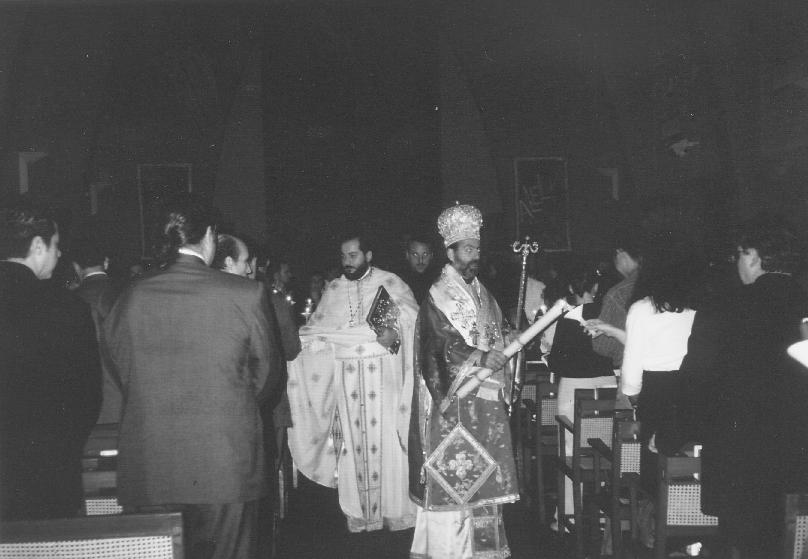
Hong Kong (AsiaNews) – The Greek Orthodox Metropolitan of Hong Kong and South-East Asia has called on the government of Beijing to grant full religious freedom to all faiths in the country and he expressed concern about the plight of Christians in Asia.
In an interview with a Catholic weekly, Archbishop Nikitas Lulias said he did not agree with the policy of the Chinese government as regards religion, given that the latter did not include Orthodoxy among the five “official religions” of the country (Catholic Christianity, Protestant Christianity, Islam, Buddhism and Taoism).
He said: “This is even more damaging if one considers the changes taking place inChina, a country that is developing rapidly. Religions should enjoy full freedom, because real social changes will soon take place alongside economical ones.”
The Metropolitan, who answers to the Ecumenical Patriarch of Constantinople, also underlined how “difficult” the situation was for Christians in many Asian countries under his spiritual jurisdiction: “Christians are ever more frequently the victims of fanaticism and unjustified hatred. We must pray that their situation may improve as soon as possible.”
A Russian Orthodox Book of Prayers published in Chinese
The Russian Orthodox Church is slowly re-emerging in China. In Shanghai a church used as a night club could be put to more proper use.
.jpg)
Moscow (AsiaNews/AFP) – China's Orthodox Christians can finally pray in their own language. Moscow's Cathedral of the Annunciation published a thousand Chinese copies of a book containing the basic principles of the Christian doctrine and the main prayers. This is the second time that it is done, but it is the first time that the book is distributed to the public.
Last summer, the book was released for consultation to a group set up by the Moscow Patriarchate to the study the place of the Orthodox Church in China.
With the new book in hand, local Orthodox believers hope that new life can be breathed into their community.
At the same time, Beijing is showing increasing signs of taking a less hard-line position against the Orthodox Church operating in its territory. Chinese authorities have allowed 18 Chinese students to attend Russian seminars in Moscow and St Petersburg.
Dmitry Napara, a Beijing Orthodox, said in an enthusiastic tone that "if these seminarians can perform their duties as priests in China, it might mean the return of Orthodoxy to the country".
The last Orthodox priest in China died last year. In June Beijing allowed an orthodox monk from Alapayevsk (Urals) to celebrate mass in Harbin, the capital of Heilongjiang province.
In an another sign of greater tolerance, the Chinese government decided that two former Orthodox churches in Shanghai—one was being used as a night club—could be put to "more proper use". One of them could become an arts centre devoted to the history of the Russian presence in China.
Sources in Moscow said that the relationship between China and the Orthodox Church was discussed during Russian President Vladimir Putin's last visit to Beijing.
There are about 12,000 Russian Orthodox in China. They are mostly descendants of Russian immigrants or Chinese converts. The Orthodox Church in China reached its high point in the mid 1950s when it had two bishops and about 20,000 faithful. However, following China's Cultural Revolution and the death of the two prelates, it went into decline. Some even feared that it might disappear altogether. (MA)
Symeon (Du) of Shanghai

His Grace, the Right Reverend Simeon (Du Runchen) of Shanghai was the bishop of Shanghai of the Church of China during the middle of the twentieth century.
Life
Born Fyodor Du on February 11, 1886 in China, Fyodor was a descendent of the Russian cossacks from Albazin who were settled in Beijing in 1685 after the Russian settlement of Albazin was destroyed by the Chinese army. His father was a church reader.
He and his family escaped miraculously from the mobs of the Boxer (Yihetuan Movement) Rebellion of 1900.
Fyodor attended theological courses at seminary classes of the Russian Orthodox Mission in Beijing. He completed these courses in 1904. After completing his studies he continued his activities at the mission as a reader and catechist. In 1908, Bishop Innocent, chief of the mission,ordained Fyodor a deacon, at the age of 22. Bp. Innocent appointed him to serve at the mission metochion, the Annunciation Church, in Harbin. In addition to his duties as deacon, Fyodor served as a missionary, the treasurer, and manager of the parish’s office in Harbin.
With the arrival of many refugee Christians from Russia in 1919, he was active in publishing Russian textbooks for the schools in Harbin.
His life as a missionary took him to many cities in China, including Shanghai, Hankou, Haimin, Kaifeng, Weihou, and Mukden, as well as to localities in Manchuria. In 1932, he was assigned to duties in Tianjin where, in 1934, he was elevated to protodeacon.
On September 16, 1941, Dn. Fyodor was ordained to the priesthood and made priest-in-charge of the St Innocent Mission Church in Tainjin. In 1943, he was elevated to archpriest and in 1945, he was awarded a “palitza”. In early 1950, Fr. Fyodor traveled to the Soviet Union, where he accompanied Patriarch Alexei to a conference in Tblisi, Georgia, of the Russian, Georgian, and Armenian Churches.
On July 23, 1950, Fr. Fyodor was tonsured a monk at Trinity-Sergius Lavra and given the name Symeon. Two days later he was raised to the dignity of archimandrite. On July 30, 1950, Arch. Simeon was consecrated Bishop of Tianjin in the Cathedral of the Annunciation in Moscow. The celebrants in the consecration were: Patriarch Alexei, Metr. Nicholas of Krutisk and Kolomna, Metr. Elevfery of Prague, Abp. Victor of Beijing, Bp. Flavian of Orlov and Briansk, and Bp. Gabriel of Vologda and Cherepvetsk.
On September 26, 1950, Bp. Simeon was installed as Bishop of Shanghai.
Bp. Simeon reposed on March 3, 1965.
Symeon (Du) of Shanghai | ||
|---|---|---|
| Preceded by: unknown | Bishop of Tianjin 1950 | |
| Preceded by: John (Maximovitch) | Bishop of Shanghai 1950-1965 | |
Εγγραφή σε:
Αναρτήσεις (Atom)